
January 16, 2026
The Key Trends Defining Early Career Recruiting in 2026
Following a year of extreme volatility and change, 2026 is shaping up to be a year of more deliberate and more constrained decision-making.
Three major forces are converging in ways that are reshaping priorities, strategies, and expectations for University Recruiting leaders:
- The AI inflection point
- Shifts in the political and policy landscape
- Ongoing economic pressure and budget scrutiny
Together, these dynamics — and the tradeoffs they create — are driving the major trends defining University and Early Career Recruiting in 2026.
At our recent webinar, Top Trends Shaping Early Career Recruiting in 2026, we explored these themes and trends in greater detail with Veris Insights’ VP of Research Strategy, Chelsea Schein, and strategic advisors Jinks Jervey and Jordan Blair-Paladino. Below, we unpack the most important implications for Early Career and University Recruiting teams as they plan for the year ahead.
The Three Forces Shaping 2026
The AI Inflection Point
We are now at a moment where AI is fundamentally reshaping the candidate experience. In our student research, about two-thirds of students report using AI during the job application process, and 60% say they believe it’s necessary to stay competitive. That belief alone is reshaping candidate behavior.
At the same time, employers are scrambling to keep up. 62% of recruiting teams report having no specific fraud detection measures in place, and 81% say the sheer volume of applications is one of their biggest challenges in identifying top talent. The result is a growing tension — an arms race of sorts between students and employers — that cuts across many of the trends shaping Early Career Recruiting in 2026.
Shifts In The Political And Policy Landscape
Recent policy changes have added a new layer of complexity for Early Career teams. Trade and tariff shifts are contributing to broader economic volatility, immigration policy continues to create uncertainty around sponsorship and future pipelines, and evolving higher education policy may reshape enrollment patterns and the long-term supply of Early Career talent.
At the same time, DEI, which was once a central value proposition of many Early Career programs, has come under increased scrutiny, forcing teams to reassess how it shows up in strategy and execution. Together, these dynamics make predictability harder and raise the stakes on planning and prioritization heading into 2026.
Ongoing Economic Pressure And Budget Scrutiny
Economic pressure remains a defining backdrop heading into 2026. Labor market data throughout 2025 reflected weak or uneven job growth, and few economists are predicting a broad-based rebound. Instead, uncertainty itself has become the prevailing planning condition.
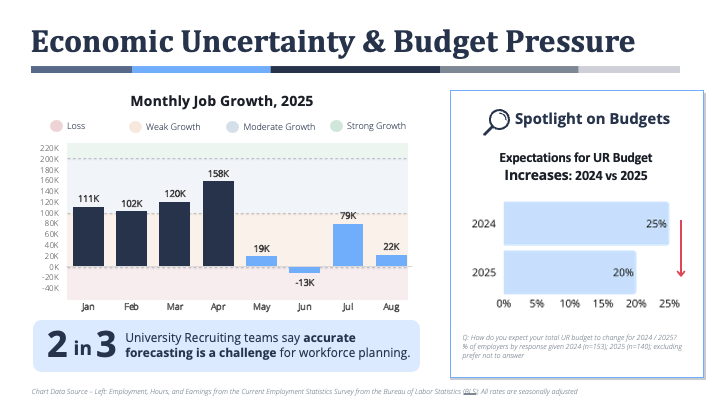
For Early Career teams, this environment is translating into heightened budget scrutiny. Fewer leaders expect budgets to grow, and many are being asked to justify spend more rigorously than in prior years. ROI, accountability, and measurable impact are no longer nice-to-have considerations — they are now central to strategy, shaping where teams invest, which programs they prioritize, and how success is defined in 2026.
The Top Trends Shaping Early Career Recruiting in 2026
Trend 1: The Year of Precision Recruiting
After several years of post-pandemic expansion and experimentation, Early Career Recruiting is entering a more focused phase. As pressure to demonstrate ROI has increased—driven by tighter budgets and broader workforce uncertainty—leaders are narrowing their strategies. Teams are shifting toward more targeted, relationship-driven, and skills-based approaches, investing more deeply where they see clear hiring outcomes and making deliberate choices about where to spend time, budget, and attention.
Chelsea and Jordan explore how this shift toward precision is showing up in day-to-day recruiting decisions.
Trend 2: A Renewed Look at School Partnerships
One of the clearest expressions of precision recruiting is how teams are rethinking school partnerships. Focus on core schools has grown from 17% in 2022 to 26% in 2025, while the share of teams describing themselves as fully school-agnostic has declined. Organizations are going deeper with fewer partners, building stronger relationships with specific schools, programs, and student organizations.
Evaluation criteria are also shifting, with increased emphasis on location, curriculum, and skill alignment to ensure campus investments translate into real hiring outcomes.
During the live Q&A, panelists addressed what this shift means for non-core schools and how students at those institutions can still position themselves for success.
Trend 3: Optimizing Recruiting with AI
2026 will likely be a significant year for AI integration within the Early Careers function. In our webinar poll, 45% of attendees said their top AI priority this year was optimizing internal recruiting processes.
Today, most internal AI adoption is focused on efficiency, e.g., drafting communications, writing job descriptions, preparing interview questions, and supporting internal workflows. However, while the value is clear, teams continue to face real barriers, including compliance concerns, integration challenges, cost, and change management. The promise of AI is evident, but implementation remains uneven, and navigating that gap will be a defining challenge in 2026.
Trend 4: Shoring Up Defenses Around AI Use
As candidate AI use increases, teams are rethinking how they assess skills and authenticity. Rising application volume, increasingly polished resumes, and emerging fraud risks are pushing employers toward more dynamic defenses. One clear response is the growing use of assessments at multiple stages of the funnel.
Importantly, many teams are not trying to eliminate AI use altogether. Instead, they are paying closer attention to how candidates use AI, recognizing it as a skill that will matter in future roles.
Trend 5: Identifying UR’s Role in Hiring AI Talent
More and more stakeholders are coming to recruiting teams asking for “AI talent,” and that tide isn’t slowing in 2026. But the question Early Career leaders increasingly have to ask is a simple one: What does AI talent actually mean for this organization, or this role?
“AI talent” can mean very different things. In some cases, it means AI-fluent generalists who can apply AI tools thoughtfully in day-to-day work. In others, it means applied AI practitioners, or, in more limited cases, highly specialized AI research scientists. Each requires a different recruiting strategy, and not all of them fit naturally within Early Career programs.
Clarifying what stakeholders really mean by AI talent is quickly becoming a critical first step for University Recruiting leaders.
Chelsea and Jordan unpack this further below.
Trend 6: Forecasting the Evolution of Early Careers
AI and automation have raised fundamental questions about the future of entry-level work. For example:
- How should roles be designed when some entry-level work can be automated?
- How should employers evaluate potential when AI tools can mask skill gaps, or artificially inflate performance?
- And more broadly, what is the value of Early Careers to the business when AI can perform work that once defined entry-level roles?
How organizations answer these questions will shape the structure and value proposition of Early Career programs throughout 2026.
To explore this in more depth, members can now access The Future of Early Careers webinar. The session examines how Early Career programs are evolving in response to AI, drawing on analysis of hundreds of programs at different stages to understand what’s changing, what’s working, and how leading teams are redefining impact.
Trend 7: UR Becomes Fluent in Data
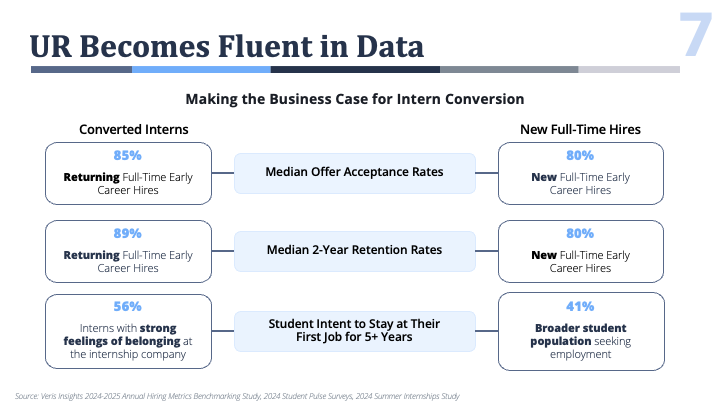
As scrutiny increases, data fluency is becoming a core capability for Early Career teams. Leaders are being asked to articulate the value of their programs with greater precision, often by pulling together data from systems that don’t always speak to one another and translating metrics into a clear business narrative.
Used well, data becomes a strategic asset. In recent employer benchmarking studies, for example, we found that returning interns tend to have higher offer acceptance rates and stronger retention outcomes — insights that directly inform investment and workforce planning decisions.
Trend 8: UR Becomes Fluent in Risk, Legal, and Compliance
Finally, Early Career teams are spending more time navigating risk, legal, and compliance considerations than ever before. AI use, assessment design, data privacy, and shifting regulations are all increasing recruiting complexity.
As a result, many leaders report closer and more frequent collaboration with legal and compliance partners, particularly over the past year. This fluency is quickly becoming table stakes. In 2026, Early Career leaders will be expected to anticipate risk, not just respond to it.
Looking Ahead
2026 is shaping up to be a challenging year, but it is also one filled with opportunity.
The forces shaping Early Career Recruiting are significant, but they are not insurmountable. Teams that invest in clarity, intentionality, and adaptability will be better positioned to navigate what comes next.
And it’s worth ending with a reminder: the work Early Career Recruiting teams do matters. The programs you design today shape the leaders, skills, and organizations of tomorrow.
Watch the full Top Trends Shaping Early Career Recruiting in 2026 webinar, including the live Q&A.